
Bleeding cash on payroll and fuel is a daily reality for DSP owners. Last-mile delivery route optimization isn't a buzzword; it's the discipline you need to master. Get it right, you're profitable. Get it wrong, you're funding your own losses.
Pinpoint Exactly Where Your Routes Leak Profit
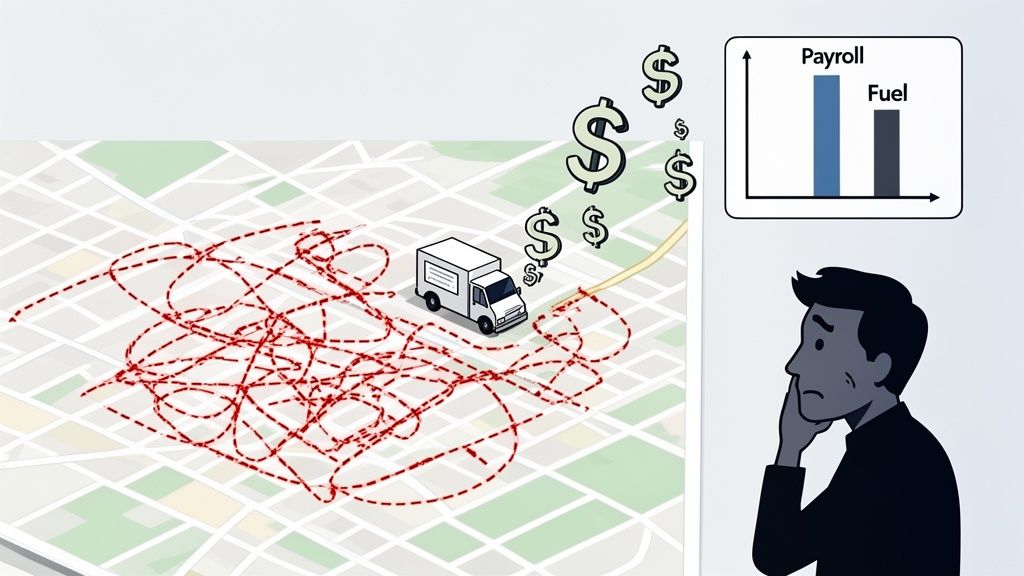
The last mile is your most expensive operational leg. It eats up to 50% of your total logistics budget. This isn't an abstract number; it's cash flowing out of your business every time a driver backtracks.
Every inefficient route hits your P&L directly. The financial bleed comes from two main sources: out-of-control overtime and wasted fuel. That extra mile or ten minutes idling seems small, but multiply it across a 40-van fleet and the numbers become staggering.
Stop Overpaying on Every Route, Every Day
The drain of a bad route is more than fuel. It's a combination of costs that compound quickly. This is what you're losing per vehicle each month.
| Cost Category | Manual Routing Cost | Optimized Routing Potential Savings |
|---|---|---|
| Excess Fuel | $250 - $400 | $50 - $80 |
| Overtime Payroll | $300 - $600 | $150 - $300 |
| Vehicle Wear & Tear | $100 - $150 | $20 - $30 |
| Driver Attrition/Retraining | $75 - $125 | $40 - $60 |
This table shows a single van can lose hundreds of dollars every month to bad routing. For a 30-van fleet, that's thousands in profit left on the table.
See How a Single Bad Route Kills Your Margin
Think about one poorly planned route. Your driver hits predictable 4 PM traffic, zigzags across a subdivision, and calls dispatch twice for clarification. That one route finishes an hour late, triggering overtime and burning fuel that should have stayed in the tank.
Imagine that scenario playing out across your entire fleet, day after day. Those small inefficiencies snowball into five or six-figure annual losses. It’s the hidden tax you pay for manual planning.
An "okay" route plan is a profit killer. Elite operators know routing isn't just about package delivery; it's a core financial strategy. Every stop must be sequenced for maximum profitability and compliance.
Turn Route Inefficiency Into Bankable Profit
Automated last-mile delivery route optimization attacks waste systematically. It's not about pushing drivers harder; it’s about giving them smarter paths. The goal is to make every route predictable, efficient, and profitable.
Advanced algorithms process thousands of data points in seconds. No human dispatcher can replicate this. They instantly factor in:
- Real-time traffic to dodge bottlenecks.
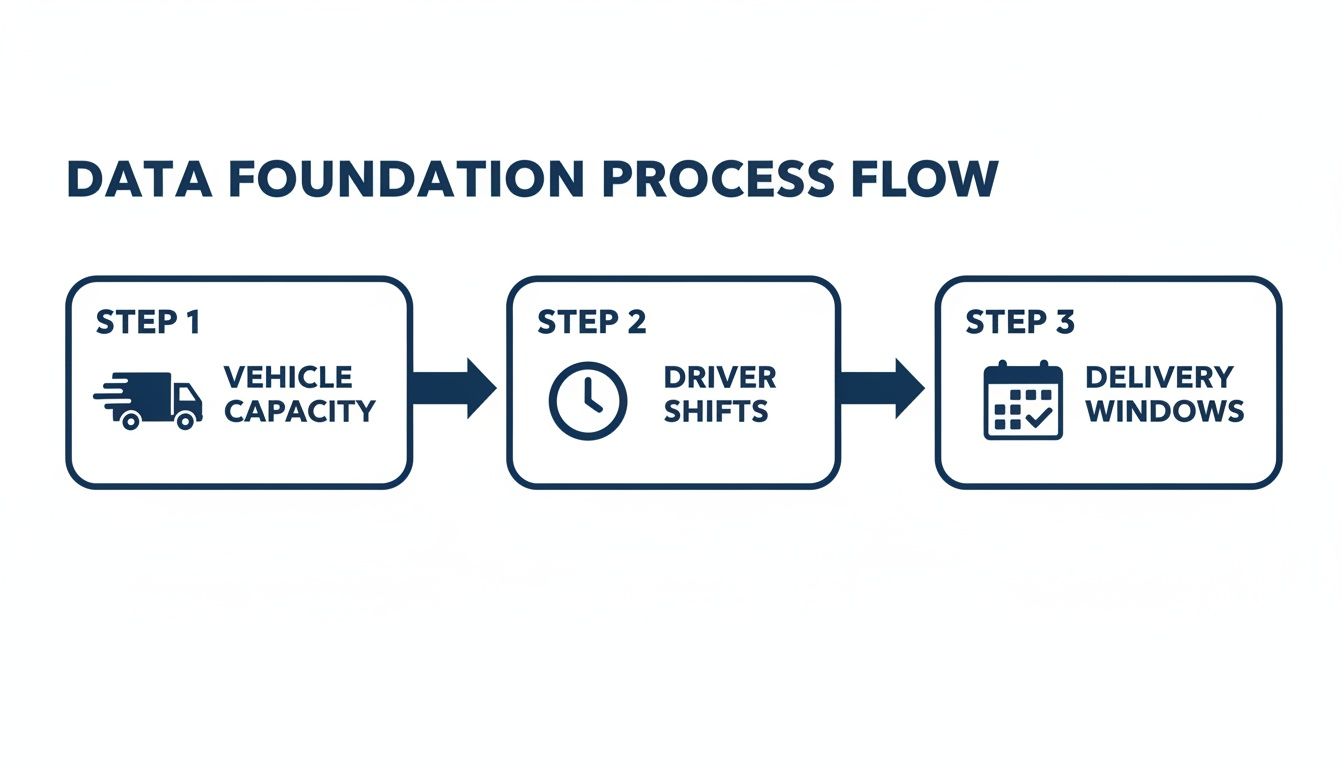
- Vehicle capacity to prevent underloaded or overloaded vans.
- Customer delivery windows to maintain high service levels.
- Driver shifts to eliminate avoidable overtime.
Operations using modern optimization tools achieve 98% on-time delivery rates. Fuel savings of 20% or more are common, along with a serious jump in fleet productivity. As detailed in this in-depth route optimization guide from DispatchTrack, routes become remarkably consistent.
This is how you stop the financial bleed. You automate the friction. This playbook shows you how.
Powered by Viki AI
Ready to build a route plan that makes you money? Let's get started.
Build a Data Foundation That Drives Profit
Bad data in, bad routes out. It's a simple truth operators learn the hard way. Your route optimization software is useless if it's running on sloppy data.
This isn't about another spreadsheet for dispatch. It's about automating data collection to create one source of truth. The best operators treat data hygiene as a core, automated part of their business.
Get Your Real-World Vehicle Constraints Right
You need to know what your fleet can handle. Not the manufacturer's spec sheet. I mean the real-world, usable capacity of every van—cubic feet, weight limits, and how shelving cuts into that space.
An overloaded van is a compliance nightmare. An underloaded van is wasted money on wheels. You need to know, down to the package, what each truck can truly carry.
Define Your Driver and Shift Parameters to Cut Overtime
Your drivers are not interchangeable. Each has specific shift rules, break needs, and skills. Your data has to reflect that human reality.
- Start/End Times: Log precise start and end times for every shift. This is the only way to stop your software from scheduling routes that bleed into costly overtime.
- Mandatory Breaks: A route plan that skips a 30-minute lunch is a fantasy. It will fall apart by midday.
- Driver Skill: Assign your veterans to dense city routes. Let newer drivers handle straightforward suburban loops. Your data should make this smart matching easy.
You can't optimize what you don't measure. A route plan that ignores your drivers' legal requirements is a direct path to chaos. Getting this data right is non-negotiable.
Use Route Data to Predict and Win
Your delivery zones are living things. Traffic, road closures, and gate-access issues change constantly. Standard map data is already behind schedule.
Collect and analyze data specific to your operating area. Look at historical traffic to know which intersections are a mess at 4 PM on a Friday. Plug into live data feeds to pivot instantly when an accident appears.
Building this data layer is fundamental and can be supercharged by using AI for data analysis. This is how you turn raw data into intelligence that predicts what's coming next.
Quantify Your Service Times to Hit Every ETA
How long does a stop actually take? If you're guessing, you're losing. You need hard numbers on the time from park to confirmation.
Dropping a package at a high-rise with a concierge takes longer than a porch drop-off. Your data has to know the difference. When 78% of consumers won't buy from a retailer again after one bad delivery, hitting your ETAs is everything.
Your system needs to know:
- The average service time for residential vs. commercial stops.
- The non-negotiable delivery windows for high-priority customers.
- The actual loading and unloading time at your warehouse.
Without this detail, your ETA predictions are fiction. Accurate service time data is the backbone of reliable customer updates and stellar on-time delivery performance.
Powered by Viki AI
Ready to build a route plan that makes you money? Let's get started.
Use Dynamic Rerouting to Master On-Road Chaos
The route plan you built at 7 AM is fiction by 9 AM. An accident snarls traffic. A road crew closes a lane. A customer issue throws your schedule off track.
A static plan sets your bottom line up for failure. The only way to win is with dynamic, real-time route optimization. It absorbs the chaos and keeps your fleet productive.
Move From Static Plans to Live Intelligence
Dynamic rerouting is the shift from "plan the work" to "work the live plan." The system sees a problem materializing and solves it before your driver calls dispatch. It's about automatically re-sequencing stops and pushing a new, optimized path to a driver's device.
Think about a major accident.
- The Old Way: The driver sits in traffic, calls dispatch. Dispatch scrambles, stares at a map, and tries to guide them out, bleeding time and money.
- The Automated Way: The system detects the gridlock from live GPS data. It instantly recalculates the most efficient path, re-sequences the next stops, and pushes the updated route to the driver. No phone call needed.
This is how you build a resilient operation. You stop reacting to chaos. You turn it into another manageable data point.
Apply the Logic of Automated Exception Handling
Dynamic rerouting asks, "What is the most profitable path right now?" It layers real-time information on top of your data foundation. This is where having your core constraints locked in becomes critical.
With these fundamentals automated, the system makes intelligent decisions on the fly. It honors your operational rules and customer promises.
The system solves a complex puzzle with moving variables:
- Traffic Delays: It calculates if it's faster to wait 15 minutes or take a 10-minute detour.
- New Orders: A high-priority pickup gets added. The algorithm finds the best driver and slots it into their sequence, minimizing disruption.
- Customer Unavailability: A driver marks a stop as failed. The system immediately removes it and tightens up the route.
- Vehicle Breakdowns: A van goes down. The system reassigns its remaining deliveries to the nearest available drivers.
A truly dynamic system doesn't just react; it anticipates. By analyzing historical traffic, it can predict which routes are high-risk and proactively build in buffers. You go from constant firefighting to strategic oversight.
Cut Dispatch Noise and Empower Your Drivers
Dynamic route optimization massively reduces driver-to-dispatch chatter. You give every driver an automated co-pilot that handles low-level problem-solving. This is a huge win for productivity and morale.
When drivers trust their routes, they focus on one thing: safe, efficient delivery. They aren't stressed about unexpected closures. This focus translates directly into higher stops per hour.
Automating on-road adjustments frees your dispatchers to manage true exceptions. They stop acting as navigators and start operating as fleet managers. That's the elite operator mindset: automate the friction so your people can dominate.
Powered by Viki AI
Ready to build an operation that thrives in chaos? Let's equip your fleet with the intelligence to win.
Align Your Driver Roster With Your Route Plan
You can build perfect routes, but they’re just lines on a map without the right drivers ready to go. When you’re short-staffed for a surge, that perfect plan falls apart. Your route plan is a direct preview of your daily labor needs.
Route optimization and staff optimization are two sides of the same coin. Treating them as one job is how you stop burning cash.
Match Route Complexity to Driver Skill
Not all routes are the same. A dense downtown core is a world away from a suburban loop. So why treat your drivers as interchangeable?
Use your routing data to create a "difficulty score" for each route. Look at stop density, historical traffic, and access issues. This is smart deployment.
Assign your toughest routes to veterans who can execute them flawlessly. This improves on-time performance and cuts down on the stress that leads to high turnover.
Your roster isn't a list of names; it’s a portfolio of assets. Deploy those assets with the same analytical rigor you apply to your fleet.
Use Performance Data to Forecast Your Labor Needs
Stop guessing how many drivers you’ll need for Prime Week. The answers are in your historical data. Analyzing past peaks gives you startlingly accurate labor forecasts.
A good system pulls the real story from your data:
- How many extra routes did we run during last year's Q4 peak?
- What was our average overtime cost per driver during that period?
- Which delivery zones saw the most volume?
This data-driven planning moves you from reactive to proactive. You build your schedule with confidence, knowing you have precisely the coverage you need. That's what a lean, profitable operation looks like.
For a deeper dive, explore our guide on how to streamline your dispatch operations, which complements these rostering tactics.
Stop Overpaying on Overtime and Idle Time
Unplanned overtime is a silent killer of a DSP's profitability. It’s a symptom of poor planning, not poor driver performance. When your route plan and schedule don't talk, you build overtime into your day.
Tie these two functions together. A modern system builds shifts that honor the route plan, ensuring enough time to complete the assignment without triggering extra pay. It also manages mandatory breaks and DOT hours of service.
The conflict gets flagged before anyone clocks in. We’ve seen operators use this to cut their unplanned overtime by over 50%.
The same logic crushes idle time. Align driver start times with when packages are ready and routes are set. Drivers arrive, load, and get on the road.
Powered by Viki AI
Ready to build a roster that powers your profitability? Let's align your people with your plan.
Use Green Routing to Lower Costs and Win Clients
Let's talk about a competitive advantage your rivals are ignoring: sustainability. This isn't about PR. It's a hard-nosed business strategy that cuts real costs and wins clients.
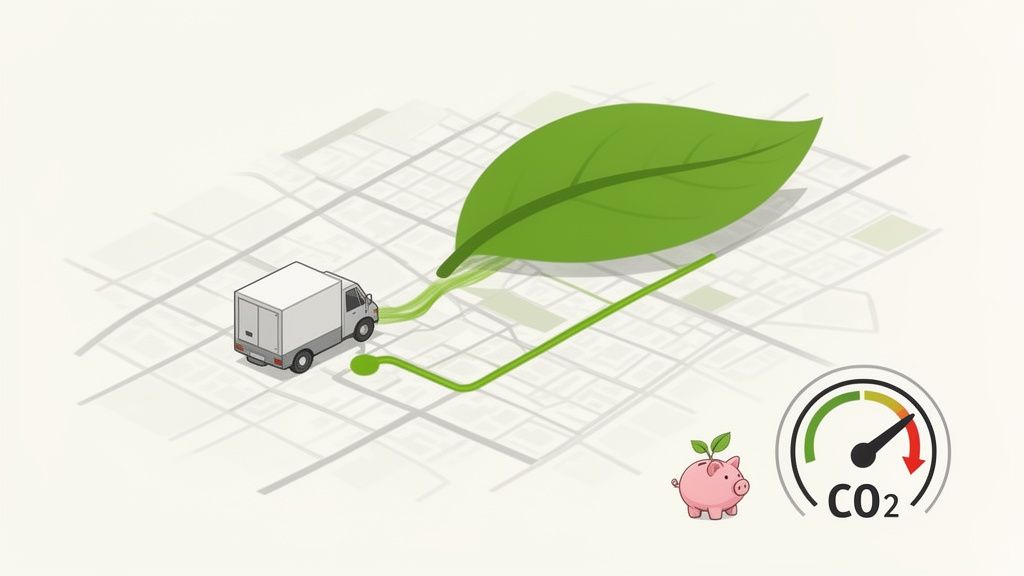
Modern route optimization is one of the fastest ways to slash your fleet's carbon emissions. The logic is simple: the shortest, most efficient route burns the least fuel.
We've seen DSPs reduce unnecessary mileage by up to 30%. This translates directly into lower fuel bills and a much smaller carbon footprint. This is how you prepare your fleet for modern urban logistics.
Turn Green Operations Into Measurable ROI
The financial case for eco-friendly routing is airtight. It's a strategy that pays you back from multiple angles. It boosts your P&L while making your business irresistible to high-value partners.
- Slash Your Fuel Spend: This is the most immediate win. Less time idling and eliminating backtracking means your fuel budget stretches further.
- Win Over Eco-Conscious Clients: Big clients are under pressure to report on Scope 3 emissions. A DSP that can provide hard data on reduced carbon output becomes a strategic partner, not just a vendor.
- Navigate Low Emission Zones (LEZs) with Ease: Cities are getting serious about vehicle emissions. A smart routing system automatically accounts for LEZs, helping you dodge hefty fines and stay compliant.
Make Eco-Routes Part of Your Daily Playbook
The best optimization software now includes "eco-routes" as a standard feature. This lets dispatchers balance emissions reduction with speed and cost. You can configure the algorithm to prioritize routes that minimize fuel consumption.
This gives you incredible operational flexibility. For a high-priority delivery, optimize for speed. For a standard run, switch to optimizing for fuel efficiency.
Top operators get it: sustainability isn't a cost center; it's a profit driver. A greener fleet is no longer a "nice to have"—it's a requirement for long-term growth in a regulated industry.
The demand for sustainability is reshaping last mile delivery. Exploring comprehensive resources on Last Mile solutions is a critical step. It helps you build a modern, resilient, and profitable fleet.
Integrate Your Tech Stack for Frictionless Operations
Your route optimization software cannot be an island. If it doesn't communicate with your other systems, you create more work and leave money on the table. Real intelligence comes from a connected tech stack.
The best operators build a central nervous system for their business. Your route platform needs to talk to your telematics, payroll, and communication tools. When connected, data flows automatically and manual friction disappears.
Connect Your Systems with APIs to Automate Work
The magic is the Application Programming Interface, or API. Think of an API as a secure digital bridge. It lets your software platforms share information automatically.
The impact is immediate. A driver completes a route, and that data instantly populates your analytics dashboard. Payroll flags a timecard issue, and you immediately cross-reference it with GPS data.
The goal is to build an operation where your systems work for you. Manual data transfer is a tax on your profitability—it invites errors and burns payroll.
Build a Single Source of Truth for Total Control
Proper integration eliminates manual data entry. It creates a single, reliable view of your entire operation. This is non-negotiable for making quick, profitable decisions.
A voice-first operating system like Viki AI becomes a game-changer for last mile delivery route optimization. It serves as the central hub. It pulls connected data together and makes it accessible through simple conversation.
- Drivers get route updates via voice commands, keeping hands on the wheel and eyes on the road.
- Dispatchers check fleet status by asking a direct question, like, "Viki, who is behind schedule on Route 12?"
- Owners get instant P&L insights by asking about the day's overtime or total fuel usage.
This unified approach is fundamental. Dive deeper into building this ecosystem in our guide to last mile delivery management software. When your data is unified, you stop managing spreadsheets and start managing a high-performance business.
Powered by Viki AI
Ready to build a system that eliminates errors and gives you total operational control? Let’s connect your tools.
Straight Talk for DSPs: Your Toughest Questions Answered
Let's cut to the chase. You have tough, practical questions about route optimization. I’ve heard them all from DSP owners like you. Here are the honest answers.
How Fast Will I See a Return on Investment?
You'll see a positive impact on your bottom line in the first 3-6 months. The most immediate gains come from a 10-20% drop in fuel costs and a sharp reduction in driver overtime. Those are real dollars on your P&L right away.
The full picture emerges over the first year. You’ll see better driver retention and an increase in packages delivered per route. It’s a snowball effect once your team finds its rhythm.
Will My Drivers Actually Use This?
Some drivers will resist. Change is hard. But adoption comes down to one thing: making their day easier.
Frame it as a tool for them. An optimized route is a calmer, more predictable day that gets them home sooner. Platforms with voice commands let drivers get updates and confirm stops without fumbling with a screen.
A huge mistake is blaming drivers for resisting tech. The problem isn't the driver; it's a bad route that makes their job harder. Give them a tool that genuinely helps, and they’ll become your biggest fans.
Can an Algorithm Really Outperform My Best Dispatcher?
Yes, but it's not about replacing their experience. It's about giving them superpowers. No human can mentally juggle live traffic, delivery windows, vehicle capacities, and driver breaks for an entire fleet at once.
This frees your dispatcher from tedious manual routing. Their role shifts from putting out fires to preventing them. You're not making them obsolete; you're elevating their expertise.
If you're weighing your options, our detailed guide on last mile logistics software offers a great overview of the technology landscape.
Powered by Viki AI
Stop running your business on guesswork. See how the first Voice-First Operating System for high-volume fleets can automate profit recovery and give you total operational control. Get a demo of voiceERP.


