
Think of last-mile logistics software as the central brain of your delivery operation. It’s the tool that automates and sharpens everything that happens from the moment a package leaves your warehouse to the second it lands on a customer's doorstep. For any Delivery Service Provider (DSP), getting this final, most expensive leg of the journey right is everything.
What is Last-Mile Logistics Software, Really?
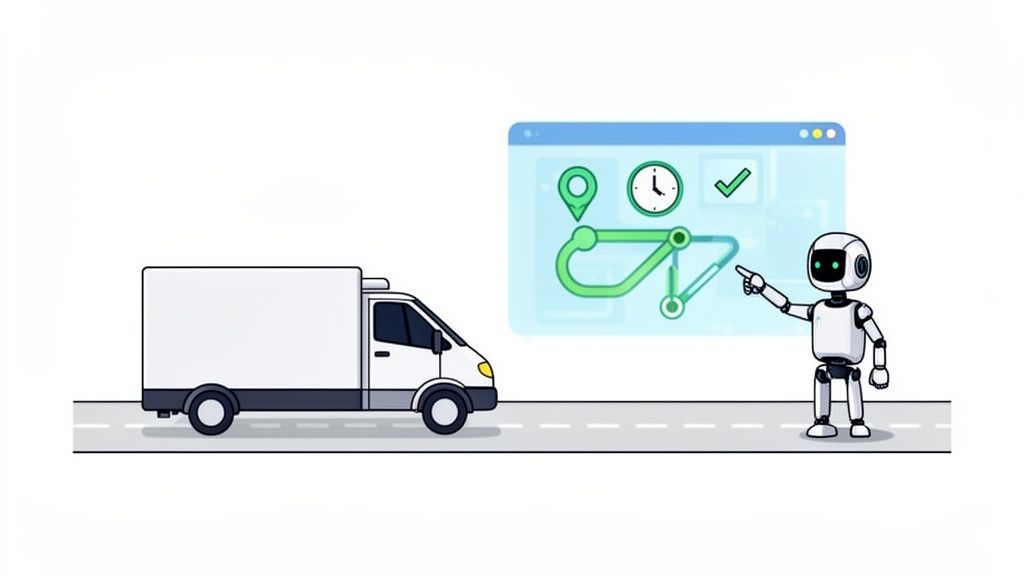
The "last mile" is where perfectly laid plans collide with the messy reality of traffic, locked apartment buildings, and last-minute customer requests. If you're running a DSP, trying to manage this stage with spreadsheets, endless phone calls, and group texts is a recipe for frustration. It’s inefficient, stressful, and leaves way too much room for costly errors.
This is exactly the problem last-mile logistics software is built to solve. It’s not just another dashboard you have to watch. It's an active system that connects your dispatchers, drivers, and customers onto a single, unified platform, turning your operation from reactive to proactive.
From Manual Guesswork to Automated Management
Without a dedicated system, many DSPs are flying blind. Once a driver pulls out of the lot, you lose real visibility. Are they on schedule? Did they run into a problem at a stop? Finding out means making a call or sending a text, which pulls you and your driver away from productive work.
This is the old, manual way of doing things. The new, automated approach gives you a complete, real-time picture of your entire fleet.
To see the difference, let's compare the two worlds side-by-side. The gap between running your DSP with manual tools versus a dedicated software platform is massive, touching every part of your day-to-day operations.
Manual DSP Operations vs Automated Management
| Operational Area | The Old Manual Way | The New Automated Way |
|---|---|---|
| Routing | Printing maps, manually planning stops, no real-time adjustments for traffic. | Dynamic route optimization, automated re-routing, considers traffic and driver breaks. |
| Dispatch | Phone calls and texts to assign jobs, hard to track who is where. | Automated job assignments based on location, availability, and vehicle capacity. |
| Visibility | A "black hole" of information once drivers leave; you only know if there's a problem when they call. | Live map tracking of all drivers, real-time status updates for every stop. |
| Communication | Messy group texts, phone tag between dispatch and drivers, manual customer updates. | Centralized in-app messaging, automated ETA alerts for customers. |
| Problem Solving | Reactive; you scramble to find a replacement driver or re-route after a problem occurs. | Proactive; the system flags potential delays and can automatically suggest solutions. |
As you can see, the shift isn't just about convenience—it fundamentally changes your operational capacity and efficiency. You move from putting out fires to preventing them in the first place.
It's More Than Just a GPS Dot on a Map
Early on, these tools were mostly about tracking. Now, they've evolved into intelligent platforms that directly boost your bottom line by automating the tasks that eat up your day.
The final delivery leg is the most critical and expensive part of the supply chain, often accounting for over 50% of total logistics costs. Software that tames this complexity is no longer a luxury—it’s a requirement for survival and growth.
The numbers back this up. The market for last-mile logistics software is exploding, jumping from USD 44.45 billion in 2025 to USD 49.04 billion in 2026, and is on track to hit a staggering USD 96.58 billion by 2032. This isn't just hype; it's a direct response to the demands of e-commerce, which requires a level of speed and accuracy that manual operations can't deliver. You can dig deeper into these market projections and their impact on logistics.
A modern platform handles crucial functions for you:
- Smart Dispatching: It automatically assigns routes to the best driver based on their location, workload, and vehicle size.
- Proactive Problem Solving: The system can spot a driver who is running late or a potential no-show and instantly start looking for a replacement.
- Centralized Communication: All updates happen in one place, ending the confusing mess of texts and calls between dispatch and your team on the road.
- Happier Customers: It sends out accurate ETAs and delivery notifications automatically, drastically cutting down on those "Where is my order?" calls.
Ultimately, this technology acts as your operational co-pilot. It takes care of the repetitive, time-sucking work, freeing you and your team to focus on what really matters: supporting your drivers and growing the business.
What to Look For: The Features That Actually Drive a DSP
When you start digging into last-mile logistics software, it's easy to get lost in buzzwords. But the truth is, not all platforms are built the same. The real difference between a basic tool and an operational command center comes down to a handful of core features that work together to make your business smoother, smarter, and more profitable.
Think of it like this: anyone can give a driver a map. The right software, however, acts like an air traffic controller for your entire fleet. It sees the whole picture, anticipates problems, and makes intelligent adjustments on the fly. That’s the leap from just tracking packages to truly managing your operation.
Dynamic Route Optimization and Automated Dispatch
The engine of any great DSP platform is dynamic route optimization. This is so much more than just finding the shortest distance between two points. A truly smart system is constantly crunching dozens of real-world variables to build the most efficient route for every single driver, every single day.
It's a complex puzzle that considers things like:
- Live Traffic Conditions: Weaving around accidents and rush hour backups.
- Delivery Windows: Hitting those critical time-sensitive drop-offs without fail.
- Driver Availability: Factoring in lunch breaks, shift times, and current workloads.
- Vehicle Capacity: Making sure you're not sending a half-empty cargo van on a route that a smaller vehicle could handle.
Once those perfect routes are calculated, automated dispatch kicks in. The software intelligently assigns the routes to the best-available drivers, eliminating the guesswork and potential favoritism that can creep in with manual assignments. This one feature alone ensures your resources are used as efficiently as possible, right from the start of the day.
A top-tier system doesn't just plan the day and hope for the best. It constantly compares the plan to what’s actually happening out on the road. This allows it to make instant, tiny course corrections that keep your entire operation running like clockwork, even when chaos strikes.
Real-Time Tracking and Proactive Communication
With your drivers on their routes, visibility becomes your most powerful tool. Modern last-mile logistics software gives you a live, bird's-eye view of your entire fleet on a single dashboard. This isn't just about watching dots on a map—it's about gaining actionable intelligence.
You can instantly see who's on schedule, who's falling behind, and where problems might be developing. This fundamentally changes your management style from reactive firefighting to proactive problem-solving. If a driver gets stuck in an unexpected traffic jam, you'll know immediately. The system can flag the at-risk deliveries and even help you reassign a nearby driver to a specific stop to keep the customer promise.
This level of coordination depends on clear communication. Integrated tools, like some of the top communication apps for logistics delivery teams, get rid of messy group texts and endless phone calls, keeping everyone on the same page.
Safety, Compliance, and Payroll Integration
Running a safe operation is everything, but the administrative side can be a nightmare. The best software takes this burden off your shoulders by connecting directly with your telematics systems, like Netradyne. It can automatically pull in and log safety events, update driver scorecards, and even help you generate incident reports.
This automated oversight helps you coach drivers and uphold high safety standards without having to watch over everyone's shoulder. This focus on automation is a huge driver of the market's growth, which is projected to jump from $3.01 billion in 2025 to $5.21 billion by 2030. We've seen how route automation can improve on-time deliveries by up to 30%, and that same level of efficiency is reflected in the 30% reduction in safety incidents that companies report when using advanced monitoring. You can dig into more of these last-mile software market trends if you're curious.
Finally, a simple but powerful feature is payroll integration. Instead of manually tracking hours and calculating bonuses, the software does it for you. It tracks every minute, applies your performance-based pay rules, and creates a file you can upload directly to your payroll provider. This small feature saves countless hours of admin work and eliminates costly human errors.
Translating Software Features Into Real-World ROI
As a DSP owner, you know that any new tech investment has to pull its weight. A long list of software features is meaningless unless it directly strengthens your bottom line. It’s all about connecting those capabilities to tangible results you can actually see on your P&L statement.
Take automated scheduling, for instance. On paper, it's just a tool for assigning shifts. But in the real world, it's a massive time-saver. Some DSPs report they get back over 100 hours per month on administrative work alone. That’s time you can put back into coaching drivers, growing the business, or just getting a bit of your personal life back.
The high-level benefits are pretty compelling right from the start.
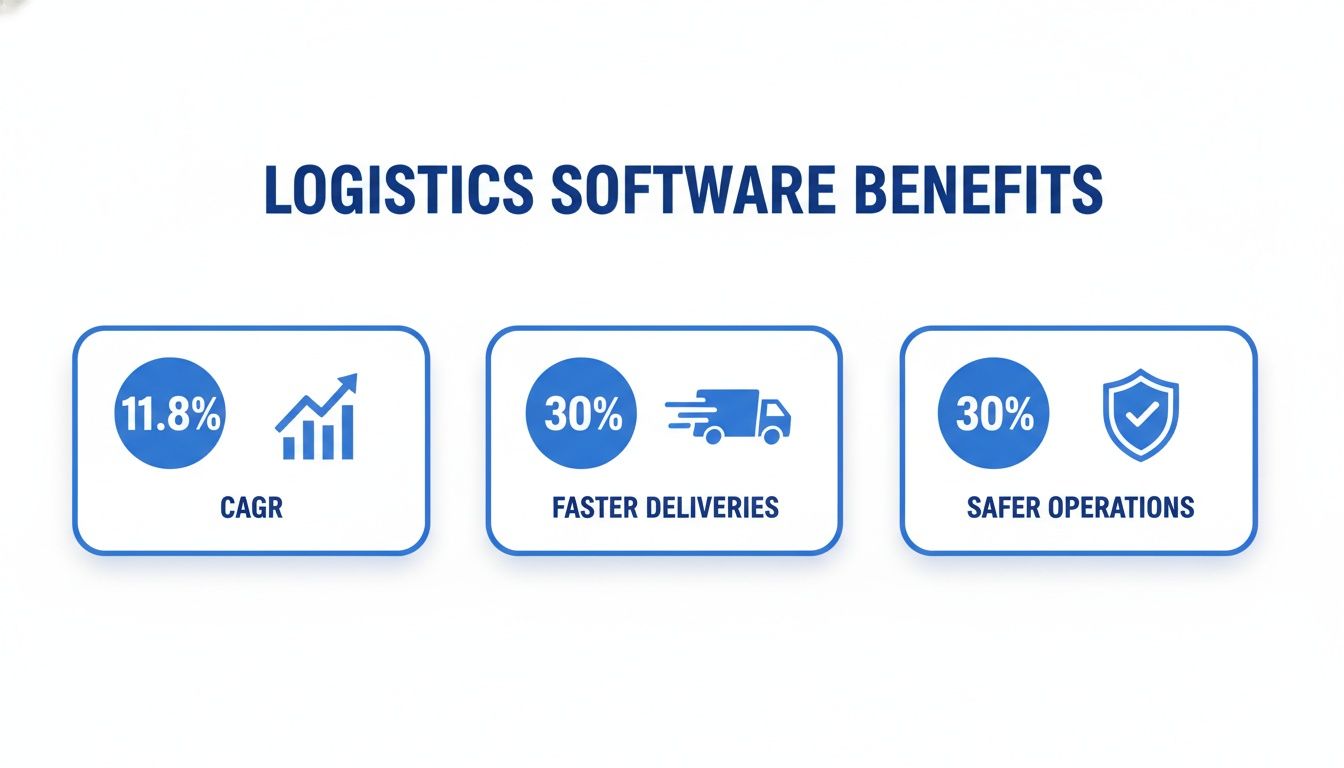
These aren't just vanity metrics. They show a clear cause-and-effect relationship between adopting the right software and getting faster, safer, and more competitive in the market.
Measuring Success Across Your DSP
The right software should make a noticeable difference in every corner of your business. To really grasp the return, you have to track the Key Performance Indicators (KPIs) that matter most. This is how you move from feeling like things are better to proving it with hard data.
Here’s where you’ll see the impact:
Operational Efficiency: This is all about doing more with less. Keep a close eye on your cost per delivery, on-time delivery rate, and packages delivered per hour (PPH). Route optimization features are designed to slash fuel costs and drive time, which naturally pushes your cost per delivery down and your PPH up.
Driver Performance: Your drivers are the engine of your operation, and good software should empower them. You’ll want to track metrics like driver safety scores, route adherence, and time spent at stops. We’ve seen systems with integrated telematics cut on-road safety incidents by up to 30%, which means fewer accidents and lower insurance premiums.
Financial Health: At the end of the day, it's all about profitability. You should see a direct drop in administrative overhead, measurable fuel cost reductions, and less money spent on driver overtime pay. A system that handles payroll calculations automatically also means no more costly human errors.
For DSPs running electric vans, the opportunity for specific savings is even greater. This is where specialized tools like Electric Vehicle Fleet Management Software come into play, helping you fine-tune EV-specific costs and operational quirks.
From Features to Financial Gains
Let's draw a straight line from a software feature directly to your bank account. It’s actually simpler than it sounds.
The whole point of great logistics software is to use operational data to automate tasks that save you money. It’s not about giving you another dashboard to stare at; it’s about making entire chunks of work disappear.
Think about these direct cause-and-effect scenarios we see all the time:
Automated Dispatch & Re-Routing: This feature builds the smartest routes, instantly cutting down the miles your drivers travel. The immediate ROI? Lower fuel bills and less wear and tear on your vehicles. It adds up fast.
Real-Time Coverage for No-Shows: A driver calls out last minute. Instead of you scrambling to find a replacement, the software finds an available, qualified driver and confirms them automatically. The ROI here is preventing a failed route, which can easily cost hundreds in lost revenue and service penalties.
Automated Payroll & Incentive Calculations: The system connects scheduling data and driver performance directly to your payroll rules, so you never have to touch a spreadsheet. The ROI is dozens of hours saved per month and a complete end to expensive payroll mistakes.
By focusing on these clear, measurable outcomes, you can see exactly how last mile logistics software will impact your business and ensure your investment starts paying for itself from day one.
How to Choose The Right Logistics Software
The market for last-mile logistics software is crowded, and frankly, telling the options apart can be a real headache. A lot of platforms will promise you the world but end up delivering little more than a complicated dashboard that just adds to your workload. For a DSP, picking the right software isn't just about cool features; it’s about finding a partner that truly gets your day-to-day grind and actually helps you solve it.
A smart investment here starts with looking in the mirror, not at a sales demo. Before you even talk to a vendor, do a quick audit of your own operation. How big is your fleet? What are your biggest daily fires to put out—is it driver no-shows, staying on top of safety compliance, or wrestling with payroll errors every two weeks?
Think about the tools you already rely on. Are integrations with your telematics, like Netradyne, or your specific payroll provider non-negotiable? Getting clear on these answers first creates a powerful filter, letting you immediately sideline any vendors that just aren’t built for your business.
Define Your Must-Have Criteria
Once you’ve got your internal needs mapped out, you can start sizing up potential software partners. It’s easy to get distracted by flashy sales pitches, so stay focused on the practical reality of using this tool every single day.
Here are the critical areas you need to dig into:
- Painless Implementation: How long will it take to get this thing up and running? A long, drawn-out setup process means weeks or even months of chaos and disruption. You want a vendor who can get you live in a matter of hours, not weeks.
- True Scalability: Your business is going to grow. You need to know if the software can keep up. Ask them how the platform handles adding more drivers, more routes, and even whole new delivery stations without lagging or breaking.
- Real-Life Support: When a critical issue pops up at 5 AM on a Saturday, who's picking up the phone? Test their support during your trial. A vendor who understands the urgency of a DSP's world will have responsive, expert help ready when you need it most.
- DSP-Specific Smarts: Does the vendor actually understand what a "no-show" costs you in real dollars and stress? Do they get the constant pressure of hitting delivery windows and managing driver scorecards? A partner who speaks your language builds a product that solves your real problems.
The best last-mile logistics software isn't just a passive tool; it becomes a proactive operational hub. It shouldn't just show you problems on a screen—it should be smart enough to fix them automatically before they can hurt your business.
This shift toward proactive automation is what's really driving the market forward. Innovations in this space are pushing the last-mile software market from USD 2,704 million in 2025 toward an estimated USD 4,677 million by 2034. As detailed in this last-mile software forecast, the true value for DSPs is in systems that can automate dispatch, coaching, and compliance by reacting to live data without needing a manager to step in.
Ask The Right Questions During Demos
Armed with your list of must-haves, you’re ready to talk to vendors. Your goal is to turn every demo into a focused investigation of your specific pain points. Don't let them just run through their standard script; make them show you, right there on the screen, how their platform solves your issues.
Here are some tough, real-world questions to throw at them:
- Driver No-Shows: "Okay, a driver just no-showed for their shift. Walk me through, step-by-step, what your system does right now to find and confirm a replacement automatically, without me having to make a dozen phone calls."
- Safety Incidents: "Show me exactly how your software connects with our telematics data. If a safety event occurs, how does it automate the write-up and update that driver’s scorecard without anyone on my team having to touch it?"
- Payroll Complexity: "We run performance-based bonuses that change weekly. How does your platform calculate these incentives and generate a file that's ready to upload to our specific payroll provider?"
Their answers—or their hesitation—will tell you everything. A confident, detailed walkthrough shows they’ve built a tool for the real world of a DSP. Vague, fuzzy responses are a major red flag that their "feature" is more of an idea on a slide deck than a function you can rely on.
By putting vendors to the test with these practical challenges, you can cut through all the marketing noise and find a true long-term partner that will actually help your business grow.
A Realistic Implementation Roadmap For Your DSP
Let's be honest, bringing in any new software can feel like a massive headache waiting to happen. But rolling out last-mile logistics software doesn't have to be a painful, drawn-out process. It's not about just flipping a switch and hoping for the best; a successful launch is methodical, but it can also be surprisingly fast.
The key is breaking it down into a few clear steps that minimize disruption and get you seeing results quickly. With a modern platform, this entire process can be done in a single day. Some systems, like voiceERP, are designed for such rapid deployment that you can be fully up and running in under six hours.
Phase 1: Pre-Launch Preparation
Before your team even knows a change is coming, the real work happens behind the scenes. This is where your new software partner connects all the dots, linking the platform to the tools your operation already relies on.
This setup phase usually involves:
- System Integration: Creating a secure link to your payroll provider, scheduling software, and critical safety systems like Netradyne.
- Data Migration: Pulling in all your essential data—driver profiles, vehicle assignments, and route history.
- Configuration: Customizing the software to fit your DSP’s unique DNA. This means setting up your specific rules for performance bonuses, safety procedures, and how shifts are assigned.
Think of it as teaching the software your playbook before the game starts. When you go live, it’s already speaking your language.
Phase 2: Team Training and Go-Live
The biggest make-or-break factor for any new tech is getting your people on board. Driver adoption is everything, but the best software makes this part easy by weaving itself into their current routine instead of just adding another app to their phone.
For your dispatchers and managers, training should be quick and to the point. They aren't learning a complicated new dashboard; they're learning to trust the automation. The goal is for them to see how the system handles routine fires, like finding coverage for a last-minute call-out, so they can focus on bigger-picture issues.
The most effective implementation is one your drivers barely notice. When the software automates communication and simplifies their day without making them learn new manual tasks, adoption is instant.
Phase 3: Post-Launch Optimization and Support
Getting the system turned on is the starting line, not the finish line. The first few weeks are all about watching, listening, and making small tweaks. A good software partner will be right there with you, helping you fine-tune the settings and ensuring everything is running like a well-oiled machine.
They should be proactive, helping you analyze the new data pouring in to spot quick wins and areas for improvement. This is when the real value becomes clear as you start to see the tangible ROI—fewer admin hours logged, lower fuel bills, and a drop in on-road incidents.
A structured implementation for your last-mile logistics software takes a project that feels daunting and turns it into a clear path toward a more efficient, profitable, and less stressful operation.
The Future Is Autonomous Logistics Management
The first wave of last mile logistics software was all about visibility. It gave you dashboards—great, big windows to look into your operation. But the next step, the one we’re living in now, is about moving beyond just seeing problems to having systems that actually solve them, often without anyone lifting a finger. This is the jump from passive monitoring to genuine autonomous logistics management.
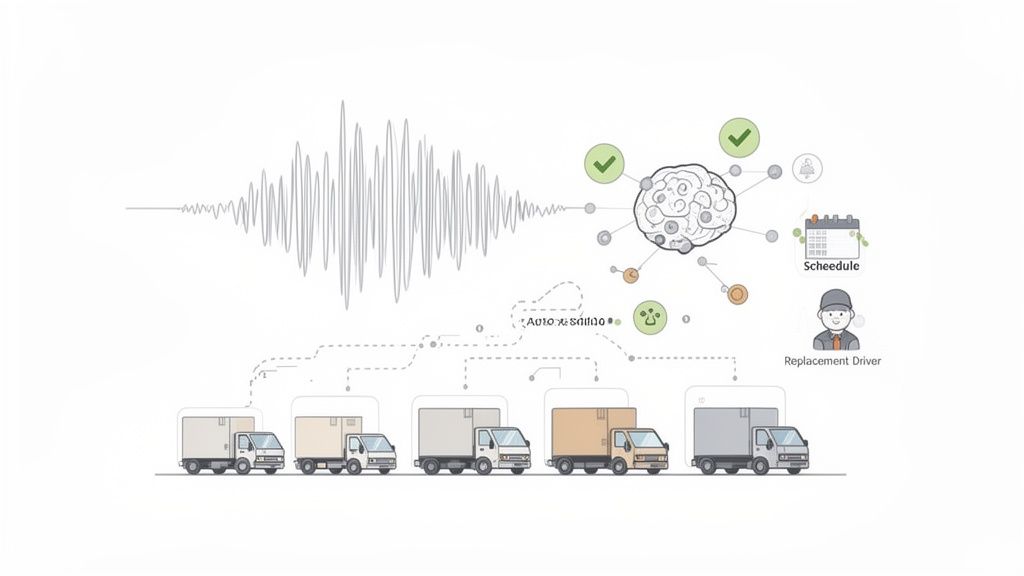
Think of it this way: for years, logistics ran on a "push" system, where everything was based on forecasts and best guesses. We're now shifting to a "pull" system, one that doesn't guess what might happen but reacts instantly to what is happening on the ground.
From Dashboards to Doers
Imagine a system that isn't just a screen you watch, but an active partner in your daily grind. That’s the core idea behind AI-powered logistics. Instead of a dispatcher staring at a screen, waiting for that dreaded "can't make it in" call, the system already knows. It sees the no-show, cross-references your roster of available drivers, and automatically sends out requests to fill the open route.
This is the heart of autonomous management: taking all the data you already have and using it to trigger smart, immediate actions. It turns your separate operational tools into a single, cohesive workforce that gets things done.
The most advanced last-mile platforms don't need you to talk to them. They "listen" to your existing data streams—scheduling, telematics, payroll—and take action based on what they hear. This is true hands-off operational control.
For example, when a telematics system like Netradyne flags a harsh braking event, an autonomous manager doesn’t just add it to a list. It can instantly update the driver's scorecard, log the event for a coaching session, and even draft a preliminary incident report, all in a matter of seconds.
How an AI Dispatcher Works in the Real World
An AI dispatcher, like our Viki, is best understood as a virtual operations manager who never sleeps, never calls in sick, and never gets overwhelmed. It constantly monitors every moving part of your DSP and executes your playbook of rules when specific events happen. This isn't science fiction—it's just smart automation applied to the messy reality of last-mile delivery.
Here’s a simple breakdown of how it operates:
- Listens to Data: It plugs directly into your scheduling software, telematics provider, and payroll system. It always knows who’s scheduled, where they are, how they’re driving, and how they need to be paid.
- Identifies Triggers: It’s trained to recognize specific events as they occur. A "trigger" can be anything from a driver failing to clock in on time to a driver finishing their route with a perfect safety score.
- Executes Actions: Once it identifies a trigger, the system automatically carries out a pre-set action. This could be anything from finding a replacement driver to calculating a performance bonus or alerting a manager to a critical safety issue.
For a DSP owner, this means entire workflows get handled without a single click. The system doesn't need to be told what to do—it already knows the plan.
The Impact of True Autonomy
This hands-off approach gives you back the one resource you can’t buy: time. It frees your dispatchers and managers from the constant, draining cycle of putting out fires. They’re no longer stuck in the weeds, scrambling to find shift coverage, manually updating safety logs, or wrestling with complex payroll incentives.
Instead, your team can finally focus on the high-value work that actually grows the business—driver coaching, strategic planning, and strengthening customer relationships. This is the real promise of autonomous last mile logistics software: it doesn’t just make your operation more efficient, it gives you back the mental space and control you need to lead it.
Frequently Asked Questions
When you're looking at last-mile logistics software, a few key questions always come up. As a DSP owner, you need straight answers before you invest your time and money. Let's tackle the most common concerns I hear about the technology, the cost, and how it actually works in the real world.
One of the biggest worries? The time commitment. But the good news is, modern systems are built for speed.
How Long Does It Take To Implement Last Mile Logistics Software?
The thought of a long, messy software rollout is enough to give anyone pause. Thankfully, those days of disruptive, weeks-long projects are largely behind us. While the timeline can vary, the best cloud-based platforms are designed to get you up and running incredibly fast.
A system like voiceERP's Viki, for example, can be fully connected with your other tools—like payroll, scheduling, and telematics—in under six hours. This means you get to skip the operational chaos and start seeing the benefits almost immediately.
Is This Software Affordable For A Small To Mid-Sized DSP?
Absolutely. You're not buying a massive, expensive software package outright. Most of today's best solutions are offered as Software as a Service (SaaS), meaning you pay a predictable monthly or annual subscription fee. This model makes it accessible for any DSP, regardless of size.
Better yet, the return on that investment shows up fast. You'll see direct savings in a few key areas:
- Reduced Fuel Costs: Smarter, more efficient routes mean you're not burning fuel on wasted miles.
- Fewer Admin Hours: Our customers consistently report saving over 100 hours per month on scheduling, payroll prep, and other back-office work.
- Improved Overall Efficiency: When your assets are used more effectively and errors are cut down, the impact goes straight to your bottom line.
Most vendors will let you try before you buy. A 30-day free trial is the perfect way to see the financial impact for yourself before making a commitment.
Will My Drivers Resist Using New Technology?
This is a perfectly valid concern. No driver wants to deal with a clunky app or a complicated new process. But the goal of good logistics software isn't to add another task to their plate—it's to make their job easier.
When software automates tedious communication or simplifies their day, it’s usually a welcome change.
The most seamless adoption happens when the software works in the background, integrating with tools drivers already use. Platforms like Viki require no new apps or manual data entry from drivers, making the transition completely frictionless for your team on the road.
Can This Software Integrate With The Tools We Already Use?
Yes, and it absolutely should. Any platform worth its salt is built to connect with the other systems you depend on. Modern logistics software uses open APIs, which are essentially built-in bridges that allow different programs to share information automatically.
This is crucial for connecting to essential tools like:
- Payroll providers
- Telematics and safety platforms like Netradyne
- Scheduling software
When your tools are connected, you create a single, reliable source of truth for all your operational data. This finally puts an end to manual data entry, spreadsheet nightmares, and endless reconciliation work.
Ready to see how an autonomous AI dispatcher can give you back 100+ hours per month and cut safety issues? voiceERP gives you the hands-off operational control to grow your business. Explore Viki with a 30-day free trial.


