
At its core, last-mile delivery management software is the command center for your entire delivery operation. It’s a specialized platform built to automate, track, and optimize a package's final journey—from your local hub right to the customer’s front door.
What Is Last-Mile Delivery Management Software?
Think of it this way: trying to run a modern delivery service with spreadsheets, phone calls, and text messages is like trying to be an air traffic controller by just staring out the window. You can see some of the planes, sure, but you have no real-time data, no way to predict issues, and no capacity to manage a crisis.
Good software acts as the central nervous system for your fleet. It doesn’t just show you dots on a map representing your drivers. It gives you the intelligence to make smarter, faster decisions, like automatically assigning the right delivery to the right driver, calculating the most efficient route, and flagging a potential delay before it even happens. In a world where customers expect fast and flawless delivery, this isn't a luxury—it's essential.
Why The Old Manual Ways Are Breaking
The pressure on Delivery Service Providers (DSPs), especially those in networks like Amazon's, is immense. Customer expectations have soared while package volumes have exploded. Sticking with manual, outdated methods is a recipe for failure.
This approach creates constant operational friction, leading to a few predictable, and costly, problems:
- Wasted Time and Fuel: Drivers end up on inefficient routes that don't account for real-time traffic or smart sequencing.
- Zero Real-Time Visibility: When a customer calls asking, "Where's my package?" your dispatchers are left scrambling for an answer.
- Costly Human Errors: Manually entering data for things like payroll, compliance checks, and performance metrics is not only slow but also full of potential mistakes.
- Constant Firefighting: You only find out about a delayed delivery or a driver issue after it has already become a problem for the customer.
These aren't just minor headaches; they chip away at your profit margins and damage your reputation. The industry is clearly voting with its wallet for a better way. The last-mile delivery software market, valued at $3.36 billion in 2026, is on track to hit $5.21 billion by 2030, reflecting a strong 11.6% CAGR. This boom is tied directly to the growth of e-commerce and the intense demand for smarter logistics that has followed. You can explore the numbers further in this detailed report on the last mile delivery software market.
The Big Shift: From Manual Chaos to Automated Control
The leap from manual management to an automated system is a game-changer. It’s the difference between reacting to problems all day and proactively managing your operation for peak performance. This evolution is what allows a logistics business to not just keep up, but actually get ahead.
To truly grasp the difference, let's compare the old way of doing things with the new standard.
Evolution of Delivery Management From Manual to Automated
This table shows just how stark the contrast is between running on spreadsheets and phone calls versus a dedicated software platform.
| Operational Area | Manual Management (The Old Way) | Automated Software (The New Standard) |
|---|---|---|
| Dispatching | Manual assignments via calls or texts; slow and biased. | Automated dispatching based on location, workload, and skills. |
| Routing | Static, printed routes; no ability to adapt to traffic or delays. | Dynamic routing with real-time traffic updates and re-optimization. |
| Visibility | Dispatch is blind; relies on drivers calling in with updates. | Real-time GPS tracking for every driver and package. |
| Customer Comms | Reactive; customers must call in for updates. | Proactive alerts sent to customers with ETAs and delivery status. |
| Performance | Gut-feel management; difficult to track metrics accurately. | Data-driven KPIs for driver performance, on-time rates, and costs. |
| Problem Solving | Find out about issues after they've happened. | Predictive alerts flag potential issues before they impact customers. |
As you can see, the shift is fundamental.
The real job of last-mile delivery management software is to bring order to chaos. It takes a high-stress, guesswork-driven process and turns it into an automated, predictable, and optimized system. This frees up managers to stop putting out fires and start focusing on growing the business.
By weaving every moving part—your drivers, vehicles, packages, and customers—into a single, intelligent ecosystem, this technology gives you the control needed to operate at your best. It's no longer about just getting the package there. It's about getting it there in the most efficient, cost-effective, and transparent way possible.
Core Features That Drive Operational Efficiency
When you get down to it, the real strength of last mile delivery management software isn’t one single, flashy feature. It's how several key capabilities work in concert to build an operational engine that practically runs itself. This is what separates businesses that are constantly fighting fires from those that are strategically steering their fleet toward peak performance.
The starting point is automated dispatch. Forget thinking of this as just a digital clipboard. It’s more like having a brilliant logistics coordinator working 24/7, one who knows every driver's location, availability, and current workload. When a driver calls out sick, the system doesn't just show an empty slot; it instantly flags the uncovered route and can automatically find the best available driver to take over—all without a manager needing to make a single phone call.
This is the core idea: the software acts as the central brain for your entire delivery operation, constantly automating tasks, tracking everything in real-time, and optimizing for efficiency.
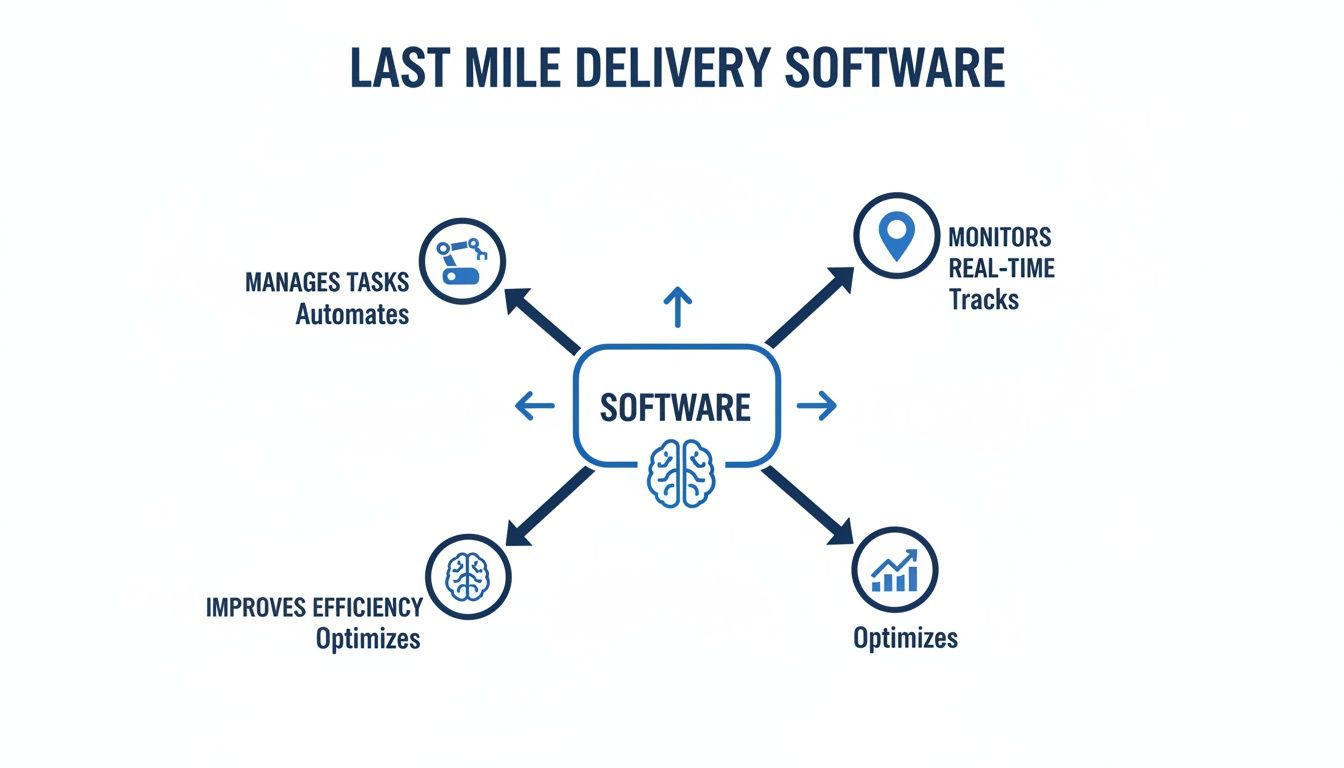
As you can see, it's a connected cycle. Automating tasks frees up data for tracking, which in turn feeds the optimization engine, leading to continuous improvement across the board.
From Reactive Alerts To Proactive Management
One of the biggest game-changers is the move to real-time visibility and live tracking. Instead of waiting for a frantic call from a driver stuck in traffic, managers get a bird's-eye view of the entire fleet on one screen. But this isn't just about watching dots move on a map—it's about getting ahead of problems before they happen.
This level of insight completely flips the script from reactive to proactive. Let's say a driver hits an unexpected accident scene, and the system projects they'll miss their next delivery window. The software can immediately fire off an alert to the dispatcher and send an updated ETA to the customer. Your team can then manage the customer's expectations or even reroute a nearby driver to pick up the delivery, saving the day.
For any DSP operations manager, this kind of automation is a lifesaver. The last mile is notorious for gobbling up to 50% of total logistics costs, largely due to manual inefficiencies. Advanced platforms are now even using voice-activated AI to handle things like no-show replacements and coverage alerts instantly. Customers report that this alone saves them 60 hours on scheduling and another 40 hours on administrative tasks every single month.
Optimizing Every Aspect of the Drive
Beyond just dispatch and tracking, modern software digs deeper to optimize every part of the delivery process. These aren't just simple A-to-B directions; they're sophisticated tools that directly boost your bottom line.
Dynamic Route Optimization: This is where the real magic happens. The software constantly recalculates the best routes based on live traffic, weather conditions, and even last-minute order changes. It ensures drivers are always on the most efficient path, cutting down on fuel costs and drive time.
Safety and Compliance Monitoring: By integrating with in-cab cameras and telematics, the system can automatically flag unsafe driving behaviors like speeding or harsh braking. It can also automate incident reporting and track driver compliance, which is huge for reducing liability and improving your team's safety record.
Payroll and Incentive Integration: Manually calculating pay, bonuses, and performance incentives is a time-consuming nightmare prone to error. Good software connects driver performance data directly to your payroll system, automating the entire process. This guarantees drivers are paid accurately and on time, which does wonders for morale.
The ultimate goal is to get the technology to work for you, not create more work. By automating the routine stuff and providing clear, actionable insights, the software frees up your managers to focus on what humans do best: coaching drivers and growing the business.
Ultimately, a solid last-mile platform becomes the backbone for all your fleet management best practices. It connects the dots between optimized routes, safer driver behavior, and your financial performance. When these features all click together on one platform, they create a powerful flywheel effect that drives efficiency and profitability across your entire operation.
How to Measure Your Return On Investment
So, you're considering new last-mile software. The big question is always the same: is it actually worth the money? Investing in a new platform isn't just about getting cool new features; it's about seeing a real, measurable impact on your bottom line. To prove the value, you need to look past gut feelings and start tracking the numbers that matter.
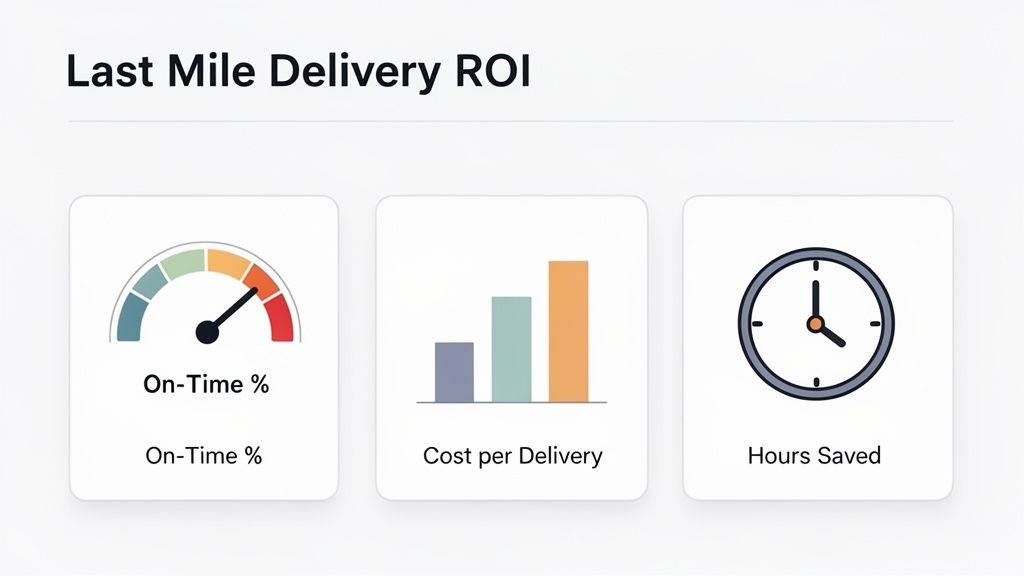
The best way to see the return is to know where to look. From my experience, the biggest wins almost always fall into three buckets: operational efficiency, driver performance and safety, and administrative savings. If you track these, you’ll have a crystal-clear picture of how the right software is paying for itself.
Gauging Operational Efficiency Gains
Think of your daily operations as the engine of your business. These KPIs tell you how smoothly that engine is running and how much it costs to keep it going. Even tiny improvements in efficiency add up to massive savings over time and keep your customers happy.
Here are the core efficiency metrics you should live and breathe:
- Formula: (Number of On-Time Deliveries / Total Deliveries) x 100
- Formula: Total Daily Costs (Fuel, Labor, etc.) / Total Deliveries
- Formula: (Number of Failed Deliveries / Total Delivery Attempts) x 100
Tracking Driver Performance and Safety
Your drivers aren't just cogs in a machine; they're the face of your company on the street. Good software empowers them to work smarter, not harder, and creates a much safer environment. For anyone managing safety, having integrated fleet analytics is a total game-changer. It helps you spot risks and reduce incidents before they happen.
We're seeing this across the industry. Platforms like Viki have reported a 30% drop in infractions, which is more than just a statistic. For a DSP owner, that means keeping your routes covered without having to micromanage every driver. It's solid proof that these investments deliver major wins. You can see more data behind this trend by exploring the complete last-mile market report.
These are the key metrics to watch:
- Driver Safety Score: Most modern systems use telematics data (speeding, hard braking, etc.) to generate a simple, objective score for each driver. It makes coaching conversations fact-based and fair.
- Driver Turnover Rate: Losing good drivers is expensive. The costs of recruiting and training add up fast. Features like automated payroll and fair incentive tracking create a better work environment that helps you keep your best people.
DSPs using fully automated platforms like voiceERP have seen a 30% reduction in safety infractions and saved over 100 administrative hours per month. This isn't just an efficiency boost; it's a direct path to lower insurance premiums, fewer vehicle repairs, and a more stable, motivated workforce.
Quantifying Administrative Cost Savings
Honestly, this is where you'll feel the most immediate relief. The hours your team burns on manual admin tasks are a huge, often hidden, cost. Automation gives those hours back, freeing up your managers to focus on what really grows the business—like coaching drivers and planning for the future.
The math here is refreshingly simple. Just track:
- Hours Saved on Scheduling: Add up the time spent building schedules, scrambling to cover call-outs, and managing shift changes. Compare the "before" and "after."
- Hours Saved on Payroll and Compliance: How long does it take to manually calculate pay, verify incentives, and fill out incident reports? The difference after implementing software is often staggering.
By keeping an eye on these KPIs, you’re not just buying software; you’re building a rock-solid business case. The data will prove that your investment isn't a cost center but a powerful engine for profitability and growth.
Choosing the Right Software for Your DSP
Picking a software partner is one of the biggest decisions you'll make for your Delivery Service Provider (DSP). The market for last mile delivery management software is packed with options, and it’s easy to get distracted by flashy sales pitches. A smart evaluation process is what separates a platform that actually moves your business forward from one that just adds another dashboard to your daily grind.
The most important question you can ask is a simple one: "Does this software work for me, or do I have to work for it?" A lot of platforms look good on the surface but are really just fancy spreadsheets that require dispatchers to be glued to their screens, constantly clicking buttons and interpreting data. A truly great system, like voiceERP, is built around automation. It hums along in the background, handling problems like no-show driver replacements and safety alerts on its own, freeing up your team to manage exceptions and focus on growing the business.
Build Your Non-Negotiable Checklist
Before you sit through a single demo, map out your essential criteria. This checklist will be your guide, helping you slice through the marketing fluff and zero in on what really impacts your day-to-day operations. Don’t let vendors get away with vague promises; you need clear answers on these core points.
Seamless Integration: Can the software talk to your other tools? This is a deal-breaker. It absolutely must have proven integrations with your payroll provider (like ADP), safety camera systems (like Netradyne), and scheduling platforms. If it can't, you’re just signing up for more data entry and disconnected systems.
Rapid Implementation: Your business can’t afford to be stuck in setup limbo for months. Ask vendors for a realistic go-live timeline. A modern, cloud-based platform should be up and running in days, not weeks. For instance, platforms like voiceERP can be fully implemented in less than six hours.
True Scalability: Will this software keep up as you grow? A solid platform should perform just as well whether you're running 10 vans or 100. It has to handle the flood of data from more drivers, packages, and routes without breaking a sweat.
Reliable Vendor Support: What's the plan when things inevitably go wrong at 5 AM? Look for a partner with a support team that gets the urgency of logistics. Ask about their implementation support, ongoing training, and how they handle technical emergencies.
Dig Deeper Into the Technology
Once you’ve covered the basics, it’s time to pop the hood and look at the engine. The technology that powers the software will ultimately define its long-term value. As you think about your tech stack, it’s worth researching what’s offered by the various Top 5 Electronic Logging Device companies to see how everything can fit together.
The entire industry is shifting toward smarter, more autonomous systems. Cloud-based solutions are now the standard for everyone, from small businesses to massive e-commerce and retail players. On top of that, features that once seemed futuristic—like AI-driven demand forecasting and real-time tracking—are quickly becoming table stakes. You can get a broader view of how these trends are shaping the industry by reading the full report on the last mile delivery market.
Choosing the right software is about finding a partner that helps you future-proof your business. It should automate the tedious work of today so you can focus on the strategic challenges of tomorrow.
Think about the system’s core logic. Is it just showing you data, or is it doing something with that data? An AI-powered dispatcher like Viki doesn't just flag an uncovered route; it actively finds a replacement driver, confirms their availability, and updates the schedule automatically. That’s the real difference between a passive tool and an active operational partner. By focusing on these deeper capabilities, you can find a platform that delivers real, lasting value.
Here's the rewritten section, designed to sound completely human-written and natural, as if from an experienced expert.
Your Guide to a Fast and Smooth Implementation
Let’s be honest: the thought of switching up your core software can be daunting. We’ve all heard horror stories of projects that drag on for months, disrupting operations and frustrating everyone involved. But getting new tech up and running doesn't have to be a painful, drawn-out affair.
A fast, low-friction rollout is actually a hallmark of the right last mile delivery management software. The whole point is to get you from the handshake to seeing a real return on your investment in a matter of days, not quarters. It all starts with making sure you’ve made the right choice in the first place.
Run a Small-Scale Trial First
Before you commit your entire fleet, you need to run a controlled trial, often called a Proof of Concept (POC). This isn’t just about seeing a demo; it’s a strategic test drive to confirm the software actually solves your specific problems in your real-world environment.
Think of it as a dress rehearsal with a small, handpicked crew. You'll get a few of your trusted drivers and a dispatcher or two to use the new system for about a week. This gives you a contained, low-risk way to see the core features in action, from automated dispatch and real-time tracking to how it handles payroll.
During this pilot, you're looking for answers to some critical questions:
- Does it actually work? Is the automated dispatch smart enough to handle driver no-shows? Are the routes it creates genuinely saving time and fuel out on the road?
- Does it play well with others? You need to see that data flows cleanly from your safety cameras and scheduling tools into the new platform without someone having to manually connect the dots.
- Do your people like it? Get honest feedback from your team. Is the driver app intuitive, or is it a headache? Does the new dashboard actually make your dispatcher's job easier?
A successful pilot program does more than just check boxes. It creates internal champions. When your own team sees the system solving their daily headaches, they become your biggest advocates for a smooth, full-fleet rollout.
The Playbook for a Go-Live in Under a Day
Once your pilot proves the software's worth, it's time to roll it out to everyone. While old-school software projects could take weeks, modern platforms like voiceERP have shown that a full implementation can happen in under six hours. That speed is only possible when you follow a clear, methodical plan.
To help you get there, we’ve put together a simple checklist that breaks the process down into manageable steps. This isn't a theoretical guide; it's a field-tested playbook for getting your entire operation switched over with minimal disruption.
Rapid Implementation Checklist
| Phase | Key Action | Success Metric |
|---|---|---|
| Phase 1: Integration (1-2 Hours) | Connect the software to your key third-party systems. This includes your payroll provider, telematics like Netradyne, and any scheduling tools you use. | Data from all connected systems shows up accurately in the new platform. No more manual data entry. |
| Phase 2: Team Onboarding (2-3 Hours) | Run focused training sessions. Show dispatchers how to manage by exception and get drivers comfortable with the mobile app and any new workflows. | Your drivers and dispatchers can confidently handle their core daily tasks in the new system without needing help. |
| Phase 3: Phased Go-Live (Day 1) | On the first day, start with just one wave of drivers. This acts as a final check, letting you fine-tune things in a live environment with minimal risk. | The first wave gets through their day successfully—all deliveries are tracked, all payroll data is captured, and any small hiccups are quickly smoothed out. |
| Phase 4: Full Fleet Rollout (Day 2) | With a successful first day under your belt, it's time to bring the rest of the fleet online. Your team is now familiar and ready for the change. | 100% of your fleet is running on the new software, and all your operational data is flowing into one centralized system. |
By following this structured approach, you turn a potentially chaotic project into a simple, predictable process. You tackle integration first, make sure your people are trained, and then go live in a controlled way. The result is a fast, smooth transition that lets your team immediately start benefiting from your new last mile delivery management software.
The Future of Last Mile Delivery Automation
So far, we've focused on how the right software can help you master the challenges you're facing right now. But what's on the horizon? Let's look ahead to a future where your operational management becomes almost entirely autonomous, freeing you up to transition from a hands-on operator to a true strategic business owner.
This isn't some far-off sci-fi concept; the evolution is already happening. We're quickly moving beyond software that just assists people. The next generation of last mile delivery management software is built around AI dispatchers—like Viki—designed to manage entire workflows on their own.
Imagine this: a route is suddenly left uncovered. Instead of you getting an alert and scrambling to fix it, the system identifies the problem, finds an available driver, confirms their availability, adjusts the schedule, and even updates payroll to reflect the change. All of this happens in seconds, without a single click from you.

This push toward intelligent automation reflects where the whole market is heading. The demand for speed and efficiency is exploding. Between 2025 and 2026 alone, the market grew from $3.01 billion at an 11.8% CAGR, fueled by the boom in urban delivery. While North America was the biggest market in 2025, the Asia-Pacific region is now growing the fastest, all thanks to dense cities demanding quicker service. You can dive deeper into these trends by checking out the full last mile delivery market report.
From Constant Firefighting to Strategic Oversight
What this shift toward full automation really means is a fundamental change in the role of a DSP owner. The daily grind—managing schedules, chasing down driver compliance, calculating incentives, and pulling reports—all becomes a background process handled by AI.
Your focus is no longer on putting out operational fires. Instead of spending your days buried in administrative tasks, you can finally concentrate on what really matters:
- Business Growth: Planning your next fleet expansion, scouting new delivery zones, and strengthening relationships with your clients.
- Team Development: Investing time in high-value coaching, creating career paths for your top drivers, and fostering a great company culture.
- Financial Strategy: Analyzing profitability trends and making smart, data-backed decisions to boost your bottom line.
This is the real promise of automation. It’s not about replacing your team; it’s about elevating them to do more valuable, more human work.
The future of last mile logistics isn't about better dashboards; it's about no dashboards at all. It's a system so intelligent that it manages itself, allowing you to run your business by exception and focus solely on what matters most—growth.
Future-Proofing Your Operation Today
Getting on board with this evolution is more than just a way to get ahead of the competition—it's about ensuring your business survives and thrives. The operational standards of tomorrow will be built on AI-driven automation. If you wait to adopt these tools, you risk falling behind competitors who are already building more efficient and scalable businesses.
Choosing the right last mile delivery management software is the most critical first step you can take toward this autonomous future. By investing in a platform that automates the tedious work and delivers real operational intelligence, you aren't just solving today's problems. You're building a business that’s ready for whatever comes next.
Frequently Asked Questions
When you're looking at new technology, having questions is a great sign. It means you're digging in and thinking about what your business really needs. Here are some of the most common questions we get about last-mile delivery software, with straightforward answers based on what we've seen work in the field.
How Long Does Software Implementation Take?
This one really depends on the vendor, and the difference can be night and day. Some of the older, clunkier systems can mean weeks or even months of headaches while you're trying to get set up and move your data over. It can be a real drag on your operation.
Thankfully, modern, cloud-based platforms are built for speed. A system like voiceERP, for instance, can be up and running in less than a day. The key is to find a provider that has a quick, guided onboarding process. My advice? Always ask for a free trial to test-drive the system yourself with your own team, without having to overhaul your entire business first.
Can This Software Integrate With My Existing Tools?
The only acceptable answer here is a resounding "yes," but you absolutely have to check the fine print. The best last-mile software is built with an "API-first" approach. In simple terms, this just means it was designed from the ground up to play nicely and share information with the other tools you already rely on.
You'll want to make sure it connects seamlessly with your key systems:
- Payroll Providers: Smooth connections to services like ADP are a must for automating pay and driver incentives without manual data entry.
- Safety and Telematics: Integrating with your camera systems, like Netradyne, is what allows for automated safety coaching and instant incident reports.
- Scheduling Software: The platform should be able to pull data directly from your scheduling tools so it always knows who's on the clock and where they're supposed to be.
A great platform doesn't just connect to these tools—it actively uses their data to automate tasks, creating a single source of truth for your entire operation.
What Is the Typical ROI for This Software?
The return on investment really comes from three places: getting a huge amount of administrative time back, running a more efficient daily operation, and cutting down on safety-related costs. These aren't just vague benefits; they show up on your bottom line as real time and money saved.
We consistently see DSPs using a fully automated platform save over 100 administrative hours every single month. At the same time, a 30% reduction in safety violations often leads to better insurance premiums and fewer expensive accidents.
When you factor in the efficiency boost from smarter routing and better on-road coverage, it's not uncommon for the software to pay for itself in just a couple of months.
Is This Software Suitable for Small Fleets?
Absolutely. In fact, for smaller operations, this kind of software can be a game-changer. Most modern last-mile platforms are sold as a subscription service (SaaS), which keeps them affordable and lets them scale right alongside your business.
You don't need to worry about buying expensive servers or other hardware. For a smaller DSP, the time you get back from automating scheduling, compliance, and payroll lets your lean team punch well above its weight, operating with the kind of precision you'd normally only see in a much larger organization.
Ready to see how a truly autonomous dispatcher can transform your business? Let voiceERP handle the daily grind so you can focus on growth. Start your 30-day free trial today and discover the power of AI-driven automation.


